Atelier RT-UQ "Deep Gaussian processes"
Dates et lieu
26 novembre 2026 à Sorbonne Université - Campus Pierre et Marie Curie dans l'Amphithéâtre Durand, 4 place Jussieu 75005 Paris.
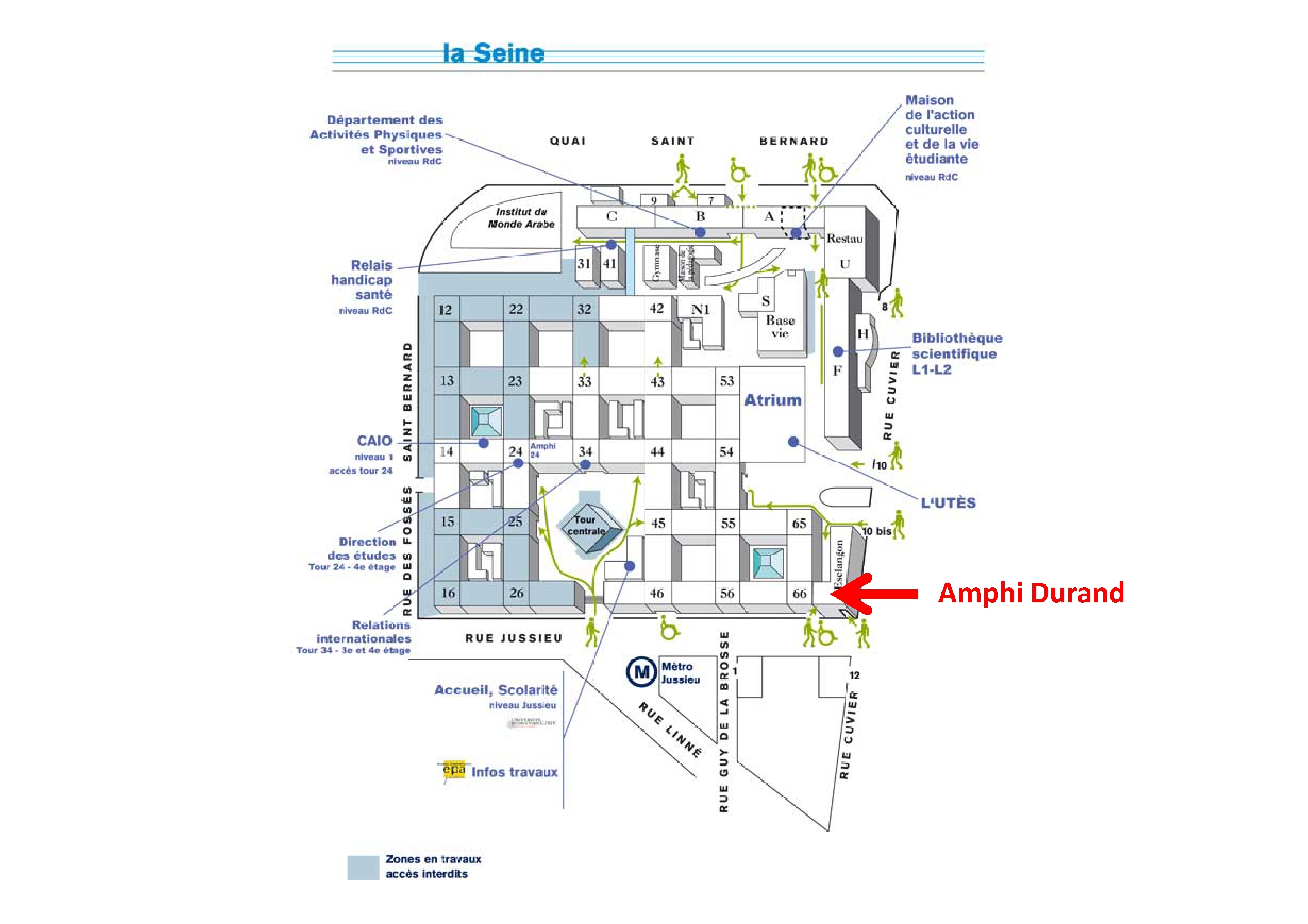
Présentation
Cet atelier est coorganisé par le RT-UQ, l'université de Lille, l'université de Toulouse et l'IFP Energies Nouvelles. L'atelier consistera en un mini cours d'une heure et 6 présentations orales de 30 minutes (+15 minutes de discussions pour chaque). La langue utilisée sera l'anglais avec des slides en français ou anglais.
Organisateurs:
Agnès Lagnoux (IMT, UT2J), François Bachoc (Université de Lille) et Miguel Munoz Zuniga (IFPEN)
Sponsorisé par: RT-UQ and IMT
Orateurs confirmés
Mickael Binois (Inria Sophia Antipolis)Franck Gabriel (Université Claude Bernard Lyon 1)
Ali Hebbal (Airbus)
Aretha L. Teckentrup (Université de Edimbourg)
Gianluca Finocchio (Université de Vienne)
Sébastien Marmin (LNE)
Oumar Baldé (CEA IRESNE)
Programme
9h - accueil9h30 - 10h30. Mickael Binois.
Introduction to deep Gaussian processes (mini-cours).
10h30 - 11h pause café
11h - 11h45. Franck Gabriel.
Neural tangent kernel: a kernel perspective on neural networks.
11h45 - 12h30. Sébastien Marmin.
From warped Gaussian processes to deep functional priors: scalable Bayesian models for calibration and uncertainty quantification.
12h30 - 14h pause déjeuner (au frais des participants)
14h - 14h45. Aretha L Teckentrup.
TBA
14h45 - 15h30. Gianluca Finocchio.
Posterior Contraction for Deep Gaussian Process Priors.
15h30 - 16h pause café
16h - 16h45. Ali Hebbal.
Geometry-Aware Deep Gaussian Process.
16h45 - 17h30 Oumar Baldé
Making Gaussian Processes deep without going deep GP.
Résumés
Gianluca Finocchio. Posterior Contraction for Deep Gaussian Process Priors.We study posterior contraction rates for a class of deep Gaussian process priors in the nonparametric regression setting under a general composition assumption on the regression function. It is shown that the contraction rates can achieve the minimax convergence rate (up to log n factors), while being adaptive to the underlying structure and smoothness of the target function. The proposed framework extends the Bayesian nonparametric theory for Gaussian process priors.
Mickael Binois. Introduction to deep Gaussian processes.
After a brief summary on the limitations of standard Gaussian processes for non-stationary response modeling, we will present an overview of the various frameworks for building deep Gaussian processes (DGP). They will be compared in terms of inference and predictions tools, as well as on the specific effects of the number of layers. Pointers on active learning strategies based on DGPs will also be provided. To complement this methodological and theoretical side, illustrative examples will be proposed in Python or R.
Ali Hebbal. Geometry-Aware Deep Gaussian Process.
Learning solutions to physical problems governed by partial differential equations (PDEs) is a critical task in engineering, yet variability in the underlying geometry of the domain often complicates it. Traditional surrogate modeling techniques struggle when faced with nonparametrized geometrical changes, such as varying mesh structures, node counts, and topologies between samples. This presentation introduces the Geometry-Aware Deep Gaussian Process (GA-DGP), a novel architecture designed to address this challenge. The GA-DGP leverages Deep Gaussian Processes (DGPs) to create a hierarchical representation of the problem. We train the entire model end-to-end by maximizing an Evidence Lower Bound (ELBO). We demonstrate the effectiveness and competitiveness of our approach on a benchmark of different physics, showing that GA-DGP achieves state-of-the-art performance while retaining the uncertainty quantification benefits inherent to Bayesian methods.
Sébastien Marmin. From warped GP to deep functional priors: scalable Bayesian models for calibration and UQ.
In this talk, I will discuss a progression from non-stationary and warped Gaussian processes to deep probabilistic models, with Bayesian calibration as an application. I will highlight how random feature approximations and variational inference make these models computationally tractable. More broadly, I will discuss connections with Bayesian neural networks and recent approaches that aim to retain explicit control over functional priors in deep models.
Oumar Baldé. Making Gaussian Processes deep without going deep GP.
Classical Gaussian process regression relies on a stationary prior, an assumption that often breaks down when building probabilistic surrogates for complex numerical simulators. This talk reviews two complementary ways of making GPs more flexible. We first review Deep Kernel Learning (DKL), which warps the input space through a neural network, and its recent Amortized Variational extension (AVDKL), designed to mitigate DKL's overfitting. We then present an alternative nonstationary GP framework in which the kernel hyperparameters are themselves modeled as neural network outputs. We propose extensions to this framework, and report results on analytical benchmarks and a real test case, before drawing connections with DKL approaches.
Franck Gabriel. Neural tangent kernel: a kernel perspective on neural networks.
In the large-width limit, different regimes can describe the training of neural networks. In one of these regimes, a neural network at initialization converges to a Gaussian process : this is a first connection between large-width neural networks and kernel methods.
During training, the Neural Tangent Kernel (NTK) provides a second connection. This kernel describes how an update on a training point influences the network predictions on other points. While the NTK is random at initialisation and changes during training for finite-width neural networks, in the so-called NTK regime, as the width tends to infinity, the NTK becomes deterministic and remains constant during training. The learning dynamics can then be described in function space using this kernel. Convergence, trajectories and generalisation properties can be related to the properties of the NTK.
This new bridge between neural networks and kernel methods has led to a large number of theoretical and practical results, including the study of neural network generalisation, early stopping, kernel alignment, sampling from posterior Gaussian processes through gradient descent, pruning and methods that directly learn to optimise the NTK. The NTK regime is understood to be a particular, first-order description of neural network training, and differs from the feature-learning regimes seen in practice. Yet, the NTK is well defined outside this regime : its evolution during training and its final structure can provide a useful way to study the similarity metric learned by a neural network.
Aretha L Teckentrup
TBA
Inscription
L'inscription est gratuite mais obligatoire.
Les inscriptions sont ouvertes jusqu'au 2 Novembre.